Manual Sanitary Napkin Vending Machines
A pad should be available the moment a woman needs one, without a queue, without a request, and without waiting for anyone to open a cupboard. That is the entire job of a manual sanitary napkin vending machine, and it is a job that a simple, well-built, non-electric machine does better than almost any other piece of washroom equipment. At Smilepad we supply manual sanitary napkin vending machines built for real institutional use, backed by a steady supply of Smilepad Ultrafresh pads so the machine on the wall is never the one that runs empty.
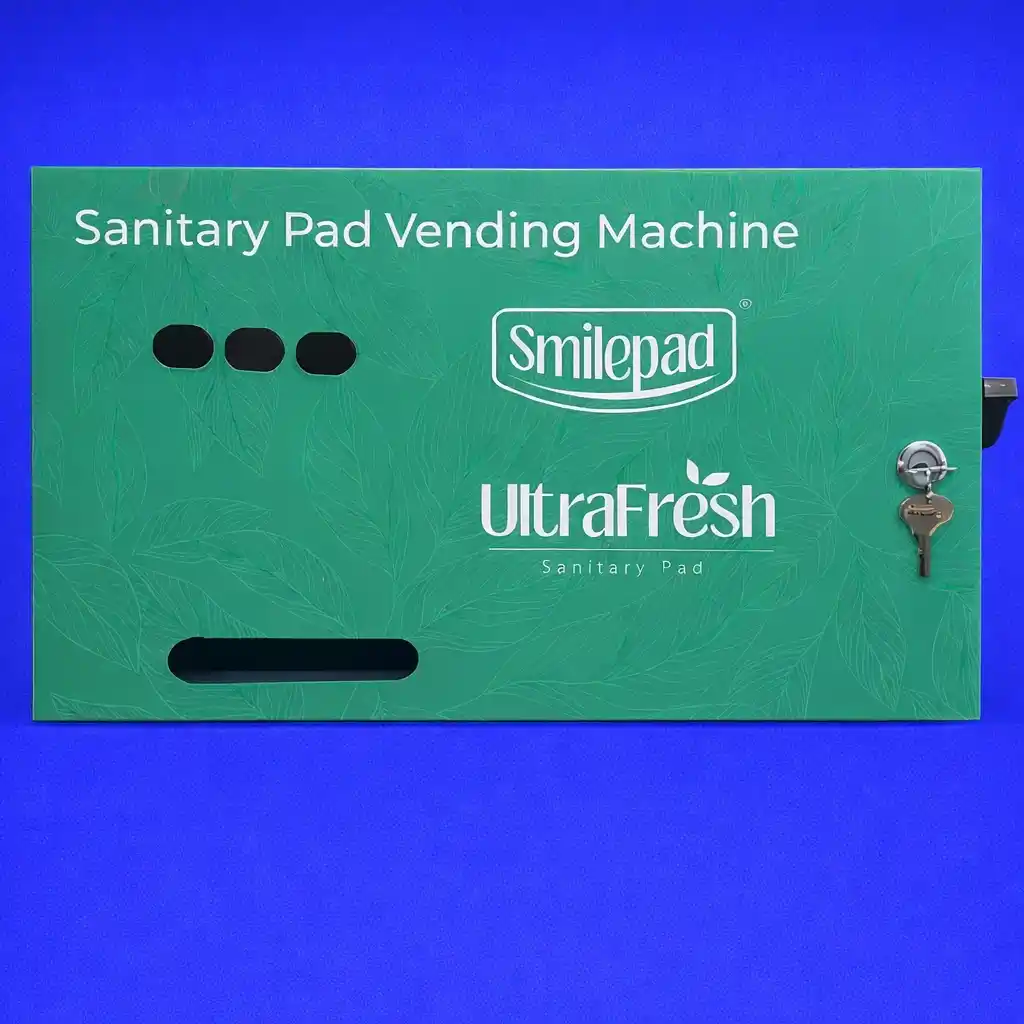
A manual sanitary napkin vending machine is a wall-mounted dispenser that releases one sanitary pad at a time through a mechanical action, either a lever, a knob, or a coin slot, with no electricity and no complicated electronics involved. It is compact, discreet, and designed to sit inside a washroom for years with very little attention. For schools, colleges, offices, hospitals, and public restrooms across India, it is the most dependable and affordable way to make menstrual hygiene an everyday certainty rather than an everyday worry.
What is a manual sanitary napkin vending machine?
A manual sanitary napkin vending machine is a non-electric sanitary pad dispenser that a user operates by hand. Instead of relying on a power supply, motors, or a screen, the machine uses a straightforward mechanical mechanism. The user pulls a lever or turns a knob, and a single individually wrapped pad drops into the collection tray. Coin-operated versions release a pad when a coin is inserted, while free-vend versions dispense a pad on every pull, which suits institutions that want to offer pads to women at no charge.
Because there are no electrical parts, a manual napkin vending machine is inexpensive to run, easy to maintain, and reliable even in locations with unstable power. That combination of low cost and high reliability is why manual machines remain the default choice for large-scale institutional deployment, where dozens or hundreds of units may be installed across a single campus or facility.
Why choose a manual, non-electric vending machine
The appeal of a manual machine comes down to three qualities that matter most in a shared washroom. It is affordable to buy at scale, it keeps working with almost no upkeep, and it removes any hesitation a woman might feel about asking for a pad. Each of those, on its own, is a good reason. Together they make the manual machine the practical backbone of any serious menstrual hygiene programme.
- No electricity required. A non-electric sanitary napkin vending machine runs on a mechanical mechanism alone, so there are no power bills, no wiring, and no downtime during outages.
- Low maintenance and long life. With a durable metal body and few moving parts, a manual dispenser is built to last, needing little more than periodic refilling.
- Discreet and dignified access. A woman collects a pad in private, on her own schedule, without a conversation, which is the single biggest reason institutions install these machines at all.
- Affordable at scale. Because the unit cost is low, a manual machine is the most economical way to cover an entire school, hospital, or office campus.
- 24x7 availability. Pads can be collected at any hour, including nights, weekends, and holidays when no staff member or shop is on hand.
The result is a measurable difference in daily life. Fewer missed classes, fewer uncomfortable hours at a desk, and fewer emergencies that should never have been emergencies in the first place.
Key features and specifications
Smilepad manual sanitary napkin vending machines are built to institutional standards, with a wall-mounted design that fits neatly into any washroom and a capacity chosen to match the footfall of the location.
| Feature | Detail |
|---|
| Type | Manual, non-electric sanitary napkin vending machine |
| Operation | Lever or knob operated free-vend, or coin-operated [confirm variant] |
| Mounting | Wall-mounted, compact footprint |
| Body material | Powder-coated MS / CRCA steel [confirm material and finish] |
| Pad capacity | 25, 50, and 100 pad options [confirm SKUs offered] |
| Compatible pads | Smilepad Ultrafresh individually wrapped sanitary napkins |
| Power | None required |
| Viewing window | Front window to monitor stock level [confirm] |
| Ideal for | Schools, colleges, offices, hospitals, hostels, factories, public restrooms |
Note for implementation: replace bracketed items with verified specifications, exact dimensions, weight, and model names before publishing.
Capacity options for every location
Not every washroom carries the same footfall, and matching the machine to the setting keeps refills manageable and stock reliable. A small office floor or a single clinic wing is well served by a compact 25-pad manual dispenser, while a busy college block, a large hospital, or a factory with a big women's workforce is better matched to a 50 or 100-pad unit that needs refilling less often. When you request a quote, our team helps you map the right capacity to the right location so no machine is oversized and none runs dry.
Where manual sanitary napkin vending machines are used
The same machine earns its place across very different settings, because the underlying need, private and immediate access to a pad, is universal. These are the environments where a manual dispenser makes the most difference.
Schools and colleges. A sanitary napkin vending machine in a school or college removes one of the most common reasons girls miss class during their periods. Non-electric machines suit campuses with many washrooms and tight budgets, and they pair naturally with awareness programmes run by the institution.
Offices and corporate workplaces. A sanitary napkin vending machine for the office signals that a company takes women's wellbeing seriously, and it fits neatly into ESG, POSH, and workplace-wellbeing commitments. Manual units keep the cost of covering multiple floors sensible.
Hospitals and healthcare facilities. In hospitals, dependable access matters for patients, attendants, and staff alike. A wall-mounted manual dispenser in maternity wings, general wards, and staff washrooms keeps hygiene within reach around the clock.
Hostels, universities, and residential campuses. Residential settings need round-the-clock access most of all, since shops are closed and help is not always nearby at night. A manual machine on every floor solves that quietly.
Factories, public restrooms, and transit hubs. Anywhere with high footfall and limited staffing, a non-electric machine offers reliable access without adding to the maintenance load.
More than a machine: the complete hygiene loop
A vending machine only delivers on its promise when the pad, the machine, and safe disposal work together as one system. A dispenser with no pads is furniture, and a pad with no hygienic way to dispose of it only moves the problem along. This is where Smilepad works differently from the many companies that sell a machine and walk away.
Every Smilepad manual vending machine is designed around a steady supply of Smilepad Ultrafresh pads and a matching approach to disposal, so access, use, and safe disposal are handled as a single connected loop. For institutions that want the whole programme managed rather than a one-off purchase, this is delivered through Nibhana Consumer Professional, the away-from-home hygiene division behind Smilepad, which sets up the machine, keeps the pads flowing, and handles disposal as one service.
That managed model also keeps the cost light. In most institutional deployments the machine itself is funded by the institution or by a CSR sponsor, while Smilepad keeps the pads supplied on an ongoing basis. You can explore the full institutional and workplace hygiene programme at Nibhana Consumer Professional to see how the machine, the ongoing pad supply, and disposal fit together for hospitals, corporates, and educational campuses.
Manual vs coin-operated vs automatic vending machines
Choosing the right type is really a question of how the machine will be paid for and how much footfall it will carry. This comparison covers the practical differences buyers ask about most.
| Manual (free-vend) | Coin-operated | Automatic (electric / UPI) |
|---|
| Power needed | None | None | Yes |
| User action | Pull lever or knob | Insert coin | Coin, UPI, or sensor |
| Best for | Free pad programmes, CSR-funded sites | Paid-access public sites | High-footfall premium sites |
| Maintenance | Minimal | Low | Moderate |
| Relative cost | Lowest | Low | Higher |
| Ideal setting | Schools, hospitals, offices | Malls, transit hubs | Large campuses, premium washrooms |
For most institutional programmes, especially those funded through CSR or run as a free service for women, the manual free-vend machine is the most sensible starting point. It is the lowest in cost, the simplest to run, and the easiest to scale across many washrooms at once.
Bulk and institutional supply across India
Smilepad supplies manual sanitary napkin vending machines in bulk to institutions across India, from a single office floor to a multi-site rollout covering an entire organisation. Whether you are equipping one hospital, a chain of schools, or a large corporate campus, our team handles capacity planning, installation guidance, and a dependable pad supply schedule so the programme keeps running long after the machines are on the wall.
For organisations planning a larger deployment, or tying the rollout to an ESG or CSR commitment, the fastest way to scope it is to book a hygiene assessment with Nibhana Consumer Professional. The team maps machine placement, capacity, pad volume, and disposal into one costed plan built for your sites.
Installation and maintenance
A manual sanitary napkin vending machine is delivered ready to mount. It fixes to the washroom wall at an accessible height, requires no electrical connection, and is ready to use as soon as it is loaded with Smilepad Ultrafresh pads. Upkeep is limited to refilling the machine and an occasional wipe-down, which any facility or housekeeping team can manage as part of a normal cleaning routine. With Smilepad's supply schedule, refills arrive before the machine runs low, so the dispenser stays stocked without anyone having to chase it.
Why buy your manual vending machine from Smilepad
Most sellers in this market offer a machine and nothing more. Smilepad offers the machine, the pad, and the programme around both, backed by a manufacturer that lives and breathes feminine hygiene. That means a dispenser that is matched to a reliable pad, a supply chain that keeps it stocked, and a team that treats a menstrual hygiene programme as something to sustain rather than something to sell once. When an institution chooses Smilepad, it is choosing access that is planned, dependable, and built to last.
Request a quote
Tell us where the machines will go and how many women they need to serve, and we will recommend the right capacity, the right pad volume, and the most cost-effective way to run the programme. Request a quote from Smilepad to install manual sanitary napkin vending machines at your school, office, hospital, or campus.
-1789562543066.png "Smilepad")