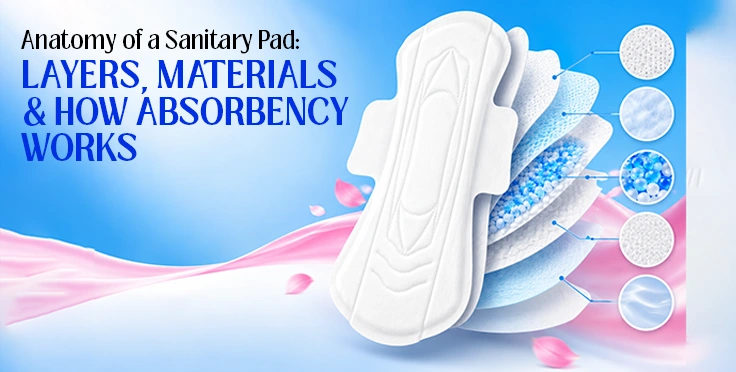
Sanitary pad layers materials determine how a sanitary pad absorbs liquid, distributes it through the core, helps prevent leakage and maintains comfort during use. A typical sanitary pad contains a topsheet, an absorbent core, a backsheet and an adhesive system. Some designs also include a separate acquisition and distribution layer. Each component serves a specific function, and their combined performance influences the product's overall quality and suitability for different markets.
For distributors, importers, private-label brands and institutional procurement teams, understanding these components is an important part of selecting the right product. A pad's appearance alone does not reveal how its materials work together or how consistently it performs.
This Sanitary Pads technical guide explains the main layers, commonly used materials, how absorbency works and what B2B buyers should evaluate before placing an order.
Why Understanding Sanitary Pad Layers Matters for B2B Buyers
Sanitary pads may look similar from the outside, but their internal construction can differ considerably. Variations in material selection, core design, layer thickness, bonding and overall construction can affect how a product handles liquid and performs during use.
For B2B buyers, these differences matter for several reasons:
Product positioning: Different retail markets and institutional programmes have different expectations regarding thickness, absorbency, surface feel and price.
Quality consistency: Buyers need products that maintain agreed specifications across repeat orders.
Private-label development: Brands must communicate product requirements clearly to their manufacturing partner.
Supply-chain planning: Material choices can influence sourcing, production processes, packaging and commercial feasibility.
Market suitability: A product intended for everyday retail distribution may require a different specification from one developed for an institutional procurement programme.
SmilePad focuses on B2B feminine-care solutions for distributors, importers, wholesalers, private-label brands and institutional buyers. Understanding the relationship between construction and performance helps buyers make informed sourcing decisions rather than selecting products based only on appearance or price.
Explore thesanitary pads product range to learn more about the product category.
Sanitary Pad Layers Materials: Understanding Each Component
A sanitary pad is a layered absorbent product. Although the exact design varies by product type and manufacturer, its principal components generally include the following.
1. Topsheet: The Surface Layer
The topsheet is the uppermost layer of the pad. It comes into contact with the body and provides the surface through which liquid enters the absorbent structure.
Common topsheet materials include:
Nonwoven fabric: Often selected for its surface feel, flexibility and ability to be engineered for liquid transfer.
Perforated polymer film: A film with openings designed to allow liquid to pass through.
Composite structures: Combinations of materials designed to balance surface feel and liquid transfer.
The material's structure, thickness, pore design and surface treatment can influence how quickly liquid passes through and how the surface feels.
For B2B buyers, the important consideration is not simply whether a topsheet is described as soft. It is whether the material performs consistently and matches the agreed product specification.
Questions to ask a manufacturer include:
What material is used for the topsheet?
Is the material nonwoven, perforated film or a composite?
What surface characteristics and liquid-transfer requirements have been specified?
Is the same specification maintained across repeat production batches?
2. Acquisition and Distribution Layer
Some sanitary pads include a separate acquisition and distribution layer, commonly called an ADL. This layer sits below the topsheet and helps move incoming liquid towards the absorbent core.
It can help distribute liquid across a wider area instead of allowing it to accumulate at one point. Its structure may also influence how quickly liquid moves away from the upper surface.
Materials used for this layer can include engineered nonwoven structures selected for liquid intake and distribution.
Not every sanitary pad has a separately identifiable ADL. In some designs, liquid transfer is managed through the topsheet and absorbent core arrangement.
For procurement teams, this distinction matters when comparing specifications. Two products may have similar external dimensions but different internal constructions.
What buyers should check:
Whether the pad includes a separate acquisition layer.
How the layer is positioned and bonded within the product.
Whether liquid intake and distribution are evaluated during product testing.
Whether the construction matches the approved sample and technical specification.
3. Absorbent Core: The Main Liquid-Handling Layer
The absorbent core is the central component responsible for retaining most of the liquid absorbed by a sanitary pad. Its composition and structure are major factors in determining overall absorbency.
Common sanitary pads materials used in absorbent cores include:
Fluff pulp: Cellulose fibres that absorb liquid and help distribute it through the core. Their arrangement influences how liquid moves and is retained.
Superabsorbent polymer (SAP): A material that can absorb and retain substantial quantities of liquid relative to its own weight. Depending on the design, SAP may be incorporated into the absorbent core to improve liquid retention.
Blended absorbent structures: Some cores combine fluff pulp and SAP to balance liquid intake, distribution, retention and product thickness.
The proportions, placement and uniformity of these materials matter. Adding more absorbent material does not automatically guarantee better overall performance. The core must also receive liquid effectively and retain it under the conditions for which the product is designed.
For a private-label brand, the choice of core should reflect the intended product specification, target price point and market expectations.
4. Backsheet: The Outer Barrier Layer
The backsheet is the bottom layer of a sanitary pad. Its main role is to help prevent liquid from passing through the underside of the product and reaching clothing.
Common materials include:
Polyethylene (PE) film: A polymer film widely used as a liquid barrier.
Breathable barrier films: Specially engineered films designed to allow some water vapour transmission while maintaining a liquid barrier, depending on their construction.
Composite backsheets: Structures that combine a barrier film with another material to change the surface feel or appearance.
A breathable backsheet should not automatically be interpreted as fully waterproof under every condition. Performance depends on the material design, construction and product testing.
B2B buyers should evaluate barrier integrity, flexibility, bonding quality and compatibility with the rest of the pad. These factors can be particularly important when a product is transported, stored and distributed across different markets.
5. Adhesive System and Release Paper
Adhesives help keep a sanitary pad positioned in underwear. Many designs use a garment adhesive on the underside and separate release paper to protect the adhesive before use.
Some pads also have side wings with adhesive areas that help secure the wings around the underwear.
The adhesive system needs to balance holding performance with practical removal. The release paper must protect the adhesive during packaging and storage while allowing it to be exposed when the product is opened.
Buyers should consider:
Adhesive placement and coverage.
Adhesion consistency.
Release-paper removal.
Adhesive transfer or residue under specified test conditions.
Packaging compatibility and storage requirements.
The adhesive is a relatively small component, but poor performance can affect the user's experience and the perceived quality of the complete product.
6. Wings, Side Barriers and Other Design Features
Additional design features may include wings, raised side barriers, embossed patterns, shaped edges and different pad lengths.
These are not necessarily separate absorbent layers. Instead, they are design elements that influence fit, positioning, liquid distribution or containment.
For example, wings are extensions that fold around the sides of underwear. Side barriers, where present, are intended to help manage lateral liquid movement. Embossing can influence the structure and arrangement of the pad's layers.
Not all products include the same features. Buyers should distinguish between a genuine construction difference and a visual variation when reviewing samples.
How Absorbency Works in a Sanitary Pad
Absorbency is not determined by a single material. It depends on how liquid enters the pad, moves through its layers, spreads within the core and remains contained during use.
For procurement and sourcing teams, understanding this process makes it easier to evaluate product samples and ask manufacturers more precise questions.
Step 1: Liquid Enters the Topsheet
The surface layer allows liquid to pass into the absorbent structure. The rate of transfer depends on the material, its openings and the overall design.
Step 2: Liquid Moves Through the Layers
Where an acquisition and distribution layer is present, it helps move liquid away from the entry point and distribute it towards the core.
Step 3: The Absorbent Core Takes Up Liquid
Cellulose fibres absorb liquid and support its distribution. When SAP is included, it absorbs and retains liquid within the core.
Step 4: The Backsheet Helps Contain Liquid
The bottom barrier limits liquid passage through the underside, while the core and overall construction influence retention and leakage performance.
Absorption, Retention and Leakage Are Different
These terms are related, but they describe different aspects of performance.
Absorption refers to the uptake of liquid by the materials.
Retention refers to how well the absorbed liquid remains held within the product.
Distribution describes how liquid spreads through the absorbent structure.
Leakage resistance concerns the product's ability to contain liquid rather than allow it to escape through the sides, underside or other areas.
A pad may absorb liquid in a laboratory test but still perform poorly if the liquid does not distribute evenly or escapes under pressure. Similarly, a core with good retention may not perform as intended if liquid cannot enter it efficiently.
This is why B2B buyers should evaluate the complete product instead of relying on one absorbency figure.
What Influences Absorbency Performance?
Several variables can influence how a sanitary pad performs:
Core composition: The materials and their proportions affect liquid uptake and retention.
Core structure: Fibre arrangement, SAP distribution and core uniformity influence how liquid moves.
Topsheet properties: Surface design affects how easily liquid enters the pad.
Layer integration: Poor bonding or uneven placement may affect the consistency of the complete product.
Product dimensions: Length, width and core geometry affect the available absorbent area and intended product design.
Test conditions: Results can vary according to the test liquid, application rate, applied pressure, waiting period and measurement method.
A stated absorbency value is meaningful only when the measurement method and test conditions are understood. Buyers should avoid comparing figures from different suppliers as though they were automatically equivalent.
Comparison Table: Sanitary Pads Materials and Their Functions
The following table provides a practical reference for buyers reviewing product specifications.
Component | Common material options | Main function | What B2B buyers should assess |
Topsheet | Nonwoven fabric, perforated film, composites | Provides the surface and allows liquid entry | Surface feel, intake and consistency |
Acquisition layer | Engineered nonwoven structures | Helps transfer and distribute liquid | Intake, distribution and construction |
Absorbent core | Fluff pulp, SAP or a blend | Absorbs and retains liquid | Core uniformity, retention and tested performance |
Backsheet | PE film, breathable barrier films, composites | Helps prevent liquid passage through the underside | Barrier integrity, flexibility and bonding |
Garment adhesive | Pressure-sensitive adhesive formulations | Holds the pad in position | Adhesion, release and residue |
Release paper | Coated paper or suitable release substrates | Protects adhesive before use | Easy removal and adhesive protection |
Wings or side features | Extensions and formed structures using suitable materials | Supports positioning or lateral containment | Construction, fit and performance |
Material options vary by product design. This table is a general technical reference, not a specification of every SmilePad product.
Thin Pads vs. Thicker Pads: Does Thickness Determine Absorbency?
Thickness is one of the most visible differences between sanitary pads, but it should not be treated as a direct measure of absorbency.
A thinner pad may use a more compact absorbent structure or incorporate SAP. A thicker pad may contain a different fibre structure or a greater volume of material. Neither construction automatically guarantees better performance.
The right comparison considers the complete design.
Evaluation factor | Why it matters |
Core material and composition | Indicates the type of absorbent structure used |
Core dimensions | Helps establish the designed absorbent area |
Liquid intake | Shows how effectively liquid enters the product under specified conditions |
Total absorption capacity | Indicates the quantity absorbed under a defined test method |
Retention under pressure | Helps assess whether liquid remains within the structure when pressure is applied |
Rewet performance | Measures liquid that transfers back towards the surface under defined conditions |
Leakage performance | Evaluates containment under the selected test conditions |
Thickness and flexibility | Helps assess the physical design and handling characteristics |
For a meaningful comparison, request test methods and results for the same performance parameters from each supplier. A larger capacity figure alone does not establish superior performance in every use condition.
Sanitary Pads Technical Guide: How B2B Buyers Should Evaluate Quality
A technical understanding of sanitary pad layers materials becomes commercially useful when it informs sourcing decisions, supplier discussions and product approval.
The following checklist can help distributors, importers and private-label brands assess samples systematically.
1. Request a Complete Product Specification
The specification should describe the product in measurable terms rather than relying only on descriptions such as premium, ultra-absorbent or extra soft.
Depending on the product, request details covering:
Product length, width, thickness and shape.
Topsheet and backsheet material types.
Absorbent core composition and construction.
Presence or absence of a separate acquisition layer.
Wing design and adhesive arrangement, where applicable.
Individual wrapping and outer packaging requirements.
Relevant product test methods and acceptance criteria.
2. Evaluate Samples Against Defined Criteria
A sample review should follow a consistent process. Buyers can prepare an evaluation sheet that records the same parameters for each supplier.
Useful checks may include:
Visual uniformity and cut quality.
Layer alignment and bonding.
Adhesive placement and release-paper removal.
Liquid intake and distribution under an agreed test method.
Absorption, retention and rewet results.
Leakage performance under specified conditions.
Packaging integrity and product identification.
Testing should use an agreed protocol and appropriate equipment where necessary. Informal demonstrations can help with initial screening, but they should not replace documented testing for commercial approval.
3. Check Batch-to-Batch Consistency
A successful sample is only the starting point. Procurement teams also need confidence that repeat orders will match the approved construction and agreed acceptance criteria.
Ask the manufacturer how product specifications are controlled and how changes in raw materials, suppliers or construction are communicated.
Where appropriate, establish a documented approval process for material substitutions, specification revisions and deviations. This can reduce the risk of receiving products that differ from the sample used for approval.
4. Match Specifications to the Target Market
The ideal product specification depends on the buyer's distribution model and intended market.
Distributors and wholesalers may prioritise a clear product range, dependable specifications and commercially viable positioning.
Importers may need documentation aligned with destination-market requirements, product labelling rules and applicable import regulations.
Private-label brands may require customised dimensions, packaging, product features and approved artwork.
Institutional buyers may need standardised specifications, defined acceptance criteria and packaging suitable for bulk distribution.
No single sanitary pad construction is automatically the best choice for every channel. Product development should begin with the buyer's requirements and then establish the most appropriate material and performance specification.
How SmilePad's B2B Approach Supports Product Selection
For a feminine-hygiene manufacturer, product quality involves more than choosing absorbent materials. The materials must work together within a consistent product design, and the finished product must align with the buyer's commercial and operational needs.
SmilePad serves B2B customers across feminine-care categories, including sanitary pads, disposable period panties, panty liners, maternity and postpartum pads, menstrual cups, tampons and sanitary-napkin vending machines. This broader product range can be relevant to buyers developing a feminine-care portfolio rather than sourcing a single product in isolation.
Material Knowledge and Manufacturing Experience
FMCG manufacturing experience is valuable when translating a buyer's product concept into practical specifications. Material selection, product construction, packaging and quality evaluation need to be considered together.
For buyers, the practical discussion should focus on the requirements of the proposed product, the agreed specifications and the testing needed before approval.
A Female Workforce and Practical Product Understanding
SmilePad has an approximately 80% female workforce. This is a distinctive part of its organisational context within feminine care.
Workforce composition alone does not establish a product's technical performance. However, understanding the product category, combined with defined specifications and quality checks, can contribute to a more informed product-development process.
Product Supply Beyond Individual Retail Purchases
Feminine-hygiene procurement can involve retailers, distributors, institutions and programmes that require coordinated product supply. An institutional hygiene-loop approach may bring together product supply, vending access and safe-disposal arrangements where appropriate.
The arrangement depends on the buyer's needs, operating environment and procurement requirements. It is worth discussing these needs early, particularly when a project involves more than the supply of packaged products.
Related Reading for Buyers and Sourcing Teams
For a more complete understanding of product selection and manufacturing, explore related resources within the SmilePad blog:
These links lead to the SmilePad blog section. Where individual articles are available, link each title directly to its relevant article to improve navigation and topical relevance.
Frequently Asked Questions
1. What are the main layers of a sanitary pad?
The main layers typically include a topsheet, an absorbent core and a liquid-resistant backsheet. Some designs also include a separate acquisition and distribution layer. Adhesives, release paper, wings and other design features support positioning and product construction.
2. What materials are used in sanitary pads?
Common sanitary pads materials include nonwoven fabric or perforated film for the topsheet, fluff pulp and sometimes superabsorbent polymer for the core, and polyethylene or engineered barrier films for the backsheet. Adhesives and release materials are also used, depending on the design.
3. What makes a sanitary pad absorbent?
Absorbency depends on the combined performance of the topsheet, any acquisition layer and the absorbent core. Core composition, material distribution, product construction and test conditions all influence how liquid is absorbed and retained.
4. Does a thicker sanitary pad absorb more liquid?
Not necessarily. Thickness alone does not determine absorption capacity. The type and quantity of absorbent materials, core structure, liquid intake and retention performance all matter. Buyers should compare products using equivalent test methods and clearly defined specifications.
5. What should B2B buyers check before sourcing sanitary pads?
Buyers should review material specifications, product dimensions, absorbency and retention results, rewet and leakage performance, adhesive quality, packaging and batch consistency. Importers should also consider applicable destination-market requirements. Product claims should be supported by suitable documentation and testing.
6. Can sanitary pad layers and materials be customised for private-label brands?
Customisation may be possible depending on the manufacturer's capabilities, available materials and product requirements. Buyers should discuss the intended market, product dimensions, absorbency expectations, packaging, order requirements and approval process with the manufacturer before finalising a specification.
Discuss Your Sanitary Pad Requirements with SmilePad
Choosing the right sanitary pad involves more than comparing prices or looking at the outer packaging. Understanding the materials, core construction and performance requirements helps buyers define a product that suits their target market.
SmilePad works with distributors, importers, wholesalers, private-label brands and institutional buyers seeking feminine-hygiene product solutions.
Planning to source sanitary pads for your business?
Request a quotation based on your product and sourcing requirements.
Ask about a free product sample to evaluate the construction and suitability of the proposed product.
Discuss private-label requirements, packaging options and relevant product specifications.
Book a call with the SmilePad team to discuss your project.
Visit theofficial SmilePad website to enquire about your requirements. You can also contact the team through its official WhatsApp business channel.
When enquiring, share your target market, product requirements and preferred day and time slot for a call so the team can discuss your sourcing needs.