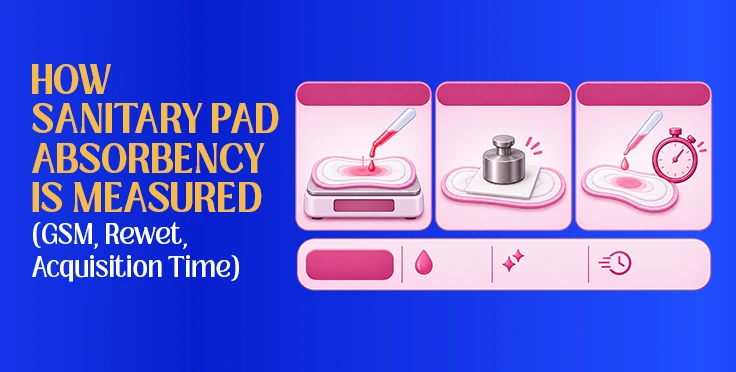
Sanitary pad absorbency measurement is the set of lab tests that show how much fluid a pad can hold and how well it handles that fluid. The three core metrics are GSM (material weight per square metre), acquisition time (how fast fluid enters the pad) and rewet (how much fluid returns to the surface under pressure).
If you buy for a distributor network, a private-label brand or an institutional tender, these three numbers decide whether a pad performs the way your customers expect. A pad can look perfect in a photo and still disappoint in use. This sanitary pads technical guide explains each metric in plain language, shows how they interact, and gives you a checklist for putting absorbency into a purchase specification.
Why sanitary pad absorbency measurement matters for B2B buyers
Absorbency is not one number. It is the combined result of the materials used, how they are layered and how the pad is converted on the line. Two pads can both be labelled “ultra thin” and behave very differently once fluid is applied.
For a B2B buyer, measurement gives you three practical things:
A shared language with your manufacturer. “Good absorbency” is an opinion. “Acquisition time and rewet within an agreed range” is a specification.
Consistency across batches. A test method that is repeated on every batch shows whether the thousandth pad matches the sample you approved.
Protection for your brand. Leakage and wetness complaints are costly for a private-label brand. Most of them trace back to a metric nobody specified.
Smilepad has manufactured feminine hygiene products in India since 2002 and supplies OEM, private-label and bulk buyers. A recurring pattern in sourcing conversations is that buyers compare pads by price and size, then discover performance differences only after launch. Putting the three metrics in the brief up front avoids that.
The three core metrics at a glance
Metric | What it measures | Typical unit | What it tells a buyer | Common pitfall |
GSM | Weight of a material layer per square metre | g/m² | How much material is used in a layer such as the top sheet, distribution layer or core | Assuming higher GSM always means better performance |
Acquisition time | Time for a measured dose of test fluid to enter the pad | Seconds | How quickly the surface clears fluid, which relates to surface dryness and leak risk | Testing a single dose only |
Rewet | Amount of fluid returning to the surface under load after absorption | Grams (or mg) | How dry the surface stays after fluid is absorbed | Comparing results from different test fluids or loads |
Total absorption capacity | Maximum fluid the pad retains | Grams or ml | The ceiling of the product’s capacity | Treating it as a substitute for rewet and acquisition |
Test fluid, dose volume, applied pressure and conditioning time all change the result. Always compare numbers that were produced under the same method.
GSM: what it tells you and what it does not
GSM stands for grams per square metre. It is a basic material property, used for nonwoven top sheets, acquisition and distribution layers, tissue wraps, core materials and back sheets.
How GSM is measured
A sample of known area is cut from the material, conditioned and weighed. The weight is converted to grams per square metre. As an illustration of the arithmetic only: a layer at 200 GSM covering 0.01 m² (100 cm²) weighs about 2 g, because 200 × 0.01 = 2. The same calculation lets you sense-check a spec sheet against a finished pad.
How to read GSM on a spec sheet
GSM is most useful when it is listed by layer rather than as a single number for the whole pad. Ask for:
What GSM does not tell you
GSM describes how much material is present, not how it behaves. A heavier top sheet is not automatically better. A very dense layer can slow fluid entry, and a lighter, well-engineered layer can outperform it. GSM is an input to performance, while acquisition time and rewet are outputs. That is why the sanitary pad absorbency measurement conversation should never stop at GSM.
Acquisition time: how quickly fluid enters the pad
Acquisition time is the time a measured dose of test fluid takes to fully disappear into the pad surface. It is usually recorded in seconds.
Why it matters
If the surface cannot take in fluid quickly, fluid can spread across the top sheet and run toward the edges. Fast acquisition is therefore linked with better surface dryness and lower leak risk. It is also the metric that most clearly separates a well-designed layer stack from a basic one.
How the test works
A pad is placed on a flat surface under a defined load or test plate.
A set volume of test fluid is delivered through an opening.
A timer records how long the fluid takes to be absorbed.
Many methods repeat the dose after a set interval and record each time.
What to ask for
The first-dose time and the repeat-dose times, because acquisition usually slows as the core fills.
The test fluid used, since synthetic fluids differ in viscosity and surface tension.
The dose volume, which should reflect the product’s intended flow level (regular, night or maternity).
Rewet: how dry the surface stays
Rewet measures how much fluid comes back to the surface when pressure is applied after the pad has absorbed a dose. Lower rewet means the surface stays drier under load, for example when the wearer sits or moves.
How the test works
Fluid is applied and given time to be absorbed.
A stack of pre-weighed filter paper is placed on the pad surface.
A defined weight is applied for a set time.
The filter paper is weighed again. The weight gain is the rewet value.
Rewet depends on how well the core locks fluid in and how well the top sheet separates the surface from it. Superabsorbent material, core design and top sheet structure all influence it.
Why buyers should care
Rewet is the metric closest to what end users call “wetness” or “stays dry”. It is often the difference between two pads that have identical total capacity. If your brand promise is dryness, rewet belongs in your specification, not just in marketing copy.
How the metrics interact
The three metrics pull against each other, and good engineering is about balance.
Faster acquisition vs. lower rewet. An open, fast-draining structure takes fluid in quickly but may release it more easily under pressure. A tighter structure can hold fluid better but slow entry.
Thinner pad vs. capacity. Ultra-thin formats use compact cores. They can perform well, but the margin for error is smaller, so repeat-dose testing matters more.
Cost vs. performance. Raising GSM or core weight raises raw material cost. Engineering the layers well can deliver better results without simply adding material.
This is why a single headline number is a weak basis for approval. A sample that wins on one metric may lose on another.
Sanitary pads materials that drive the numbers
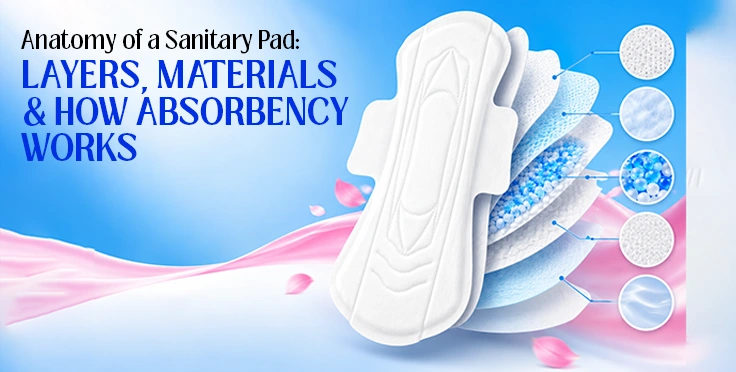
Understanding sanitary pads materials makes the test results easier to interpret. A typical pad is a layered system:
Top sheet: the surface layer that contacts the user. Its structure and finish affect acquisition and rewet.
Acquisition/distribution layer (ADL): spreads fluid and moves it down into the core, helping both speed and dryness.
Absorbent core: commonly fluff pulp with superabsorbent polymer, or other core constructions. This drives total capacity and fluid retention.
Back sheet: the barrier layer that helps prevent strike-through.
Adhesives and release paper: these affect positioning and handling, and they appear in a complete material spec.
Format also changes how these materials are used. For example, ultra thin sanitary napkins rely on compact cores, maxi sanitary napkins carry more core volume, and night sanitary napkins need longer coverage and higher capacity. Specialised options such as graphene sanitary napkins, anion sanitary napkins and biodegradable sanitary napkins change the material mix, so their absorbency should be tested on their own results rather than assumed from another product.
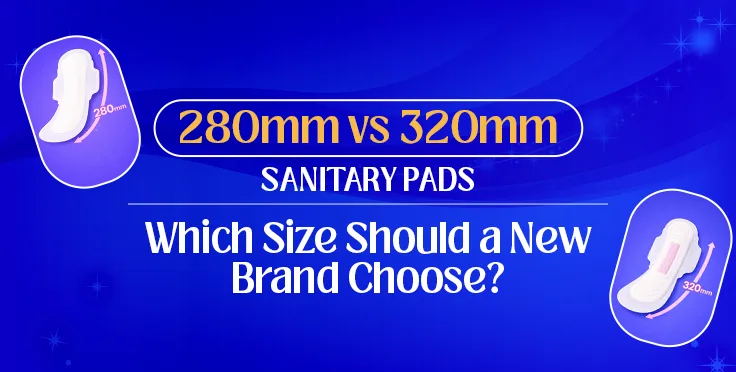
Size matters as well. If you are still deciding between formats, our comparison of 280mm vs 320mm sanitary pads explains how length affects coverage and what a new brand should consider.
Standards and testing: where the numbers come from
Absorbency results only mean something when the method is defined. Buyers typically work with a combination of national standards, internationally recognised test methods and the manufacturer’s own in-house procedures.
At Smilepad, prototypes go through in-house performance and safety testing during sampling, against parameters defined in IS 5405, before production begins. You can see how this stage fits into the full process on our sampling and testing page, and how materials and layer design are decided on the product engineering page.
Two practical notes for buyers:
Standards are revised from time to time, so check which edition applies to your target market.
Export markets may ask for additional documentation or different test methods. Raise this early in the brief.
A buyer’s checklist: writing absorbency into your specification
Use this list when you request samples or draft a purchase specification for your sanitary pad range.
Define the product type and size (for example 240mm regular, 280mm XL, 320mm XXL).
Request GSM by layer, not a single total.
Ask for acquisition time for first and repeat doses, with the dose volume stated.
Ask for rewet under a stated load and time.
Require the test fluid and method to be named on every report.
Agree acceptance ranges, not single target values, so normal process variation is allowed for.
Ask for a sample from a production run, not a hand-made prototype.
Request batch-level testing so you can compare production lots against the approved sample.
Confirm the packaging and storage conditions, since moisture exposure can affect material behaviour.
If you are building a range, you can browse the full sanitary napkins category and the sanitary pad page to match formats to your market. Smilepad offers OEM and private-label supply with custom sizes, absorbencies and materials.
Common mistakes in sanitary pad absorbency measurement
Comparing a sample against a competitor on different methods. Results are only comparable under the same fluid, dose and load.
Approving on total capacity alone. Capacity says nothing about surface dryness or speed.
Testing one pad. Variation between pads is normal. Ask how many units were tested.
Ignoring repeat-dose behaviour. Real use involves more than one release of fluid.
Skipping the material spec. Without layer details, you cannot reproduce or defend the result later.
Beyond the pad: the institutional angle
Institutional buyers such as schools, workplaces, NGOs and government programmes rarely buy the pad alone. Supply, dispensing and disposal shape the whole programme. Smilepad’s approach connects product supply with sanitary napkin vending machines and sanitary napkin disposal bins, so a buyer can plan the full cycle with one partner. Absorbency measurement still sits at the centre of that plan, because it defines which pad you are committing to supply at scale.
Frequently asked questions
What is the most important metric in sanitary pad absorbency measurement?
No single metric is enough. GSM describes the material, acquisition time shows how fast the pad takes in fluid, and rewet shows how dry the surface stays. Buyers should specify all three, along with total capacity.
Does a higher GSM mean a more absorbent sanitary pad?
Not necessarily. GSM only shows how much material is in a layer. Performance depends on the material type, how layers are combined and how the pad is made, so acquisition time and rewet give a clearer picture.
What is rewet in a sanitary pad?
Rewet is the amount of fluid that returns to the pad surface under pressure after the pad has absorbed a dose. It is measured by weighing filter paper before and after it is pressed on the pad. Lower rewet means a drier surface.
What is acquisition time and why does it matter?
Acquisition time is how long a measured dose of test fluid takes to enter the pad. It shows how quickly the surface clears fluid. Buyers should ask for first-dose and repeat-dose results.
Which test standard should I follow?
This depends on your target market. IS 5405 is a reference point for sanitary napkins in India, and export markets may require other methods. Confirm the current edition and any destination-market requirements before finalising your spec.
Can I get absorbency customised for my private-label range?
Yes. Smilepad works with OEM and private-label buyers on sizes, absorbencies and materials. Share your target product type and market, and the team can propose a specification and send samples for your own testing.