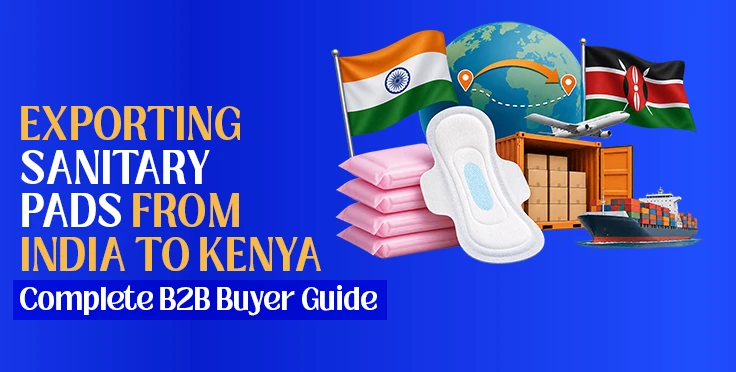
A sanitary pads exporter India Kenya buyers can rely on is a manufacturer that supplies bulk, private-label or branded pads under HS 9619. It also arranges export paperwork and the KEBS Certificate of Conformity, and ships to Mombasa by sea or Nairobi by air on agreed Incoterms. This guide walks Kenyan importers through each step.
If you plan to import sanitary pads Kenya wide, whether for a distribution network, a private-label range or an institutional programme, the product itself is only half the decision. The other half is compliance, documentation and logistics. Getting those wrong is what causes delays at the port.
Why Kenyan buyers source from India
Kenya’s market has strong demand for affordable, reliable feminine hygiene products. Importers and distributors look for three things from a supplier: consistent quality, flexible pack sizes, and a partner who understands port clearance. Many buyers searching for sanitary pads suppliers Kenya options end up comparing a local converter against an Indian manufacturer, and the comparison usually comes down to range, customisation and landed cost.
Smilepad is a sanitary pads manufacturer India buyers can work with directly. We are a contract manufacturer and exporter, not a consumer brand, so our work is built around distributors, importers, private-label brands, wholesalers and institutional buyers. We have manufactured feminine hygiene products in India since 2002 and serve buyers in more than 20 countries. You can see our Kenya-specific supply details on theKenya export page and our widerexport hub.
What you can source: product range for Kenya
Most Kenyan orders start with core formats and expand from there. A typical range conversation covers:
Regular, XL and XXL pads. Oursanitary pad range covers common lengths, and the widersanitary napkins category includes ultra thin, maxi and night formats.
Maternity and postpartum pads. See ourmaternity pads for hospital and clinic supply.
Panty liners and period panties for complementary range building.
Private label and OEM. We offer custom sizes, absorbencies and materials, from low MOQs to bulk and export orders.
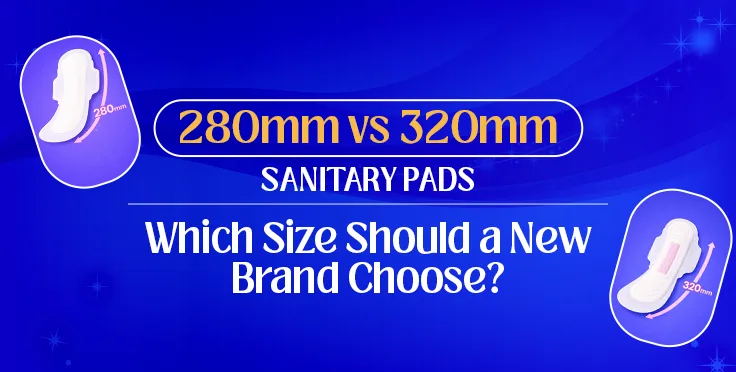
If you are deciding between formats for a new Kenyan brand, our guide to280mm vs 320mm sanitary pads is a good starting point.
HS code for sanitary pads
Sanitary towels (pads), tampons and similar articles are classified under HS 9619. India’s export data shows national tariff lines beneath that heading, for example 9619.00 at the six-digit level and 96190010 or 96190090 at the Indian eight-digit level. Your Kenyan clearing agent will confirm the exact tariff line used at import.
Why this matters: the HS code drives the duty calculation, the import declaration and any standards check. Make sure the code on your commercial invoice, packing list and Import Declaration Form (IDF) match exactly. Mismatched codes are a common cause of queries at customs.
Import duties and taxes
Kenya applies East African Community (EAC) customs rules, and duty and VAT treatment of hygiene products can change with budgets and finance acts. We therefore do not quote a fixed rate in this guide. Before you place an order:
Ask your clearing agent or the Kenya Revenue Authority for the current duty, VAT and levy position for your exact tariff line.
Request a landed-cost estimate that includes duty, VAT, port charges, inspection fees and inland transport.
Check whether any preferential or exemption arrangement applies to your import category.
We recommend building the landed-cost calculation into your price comparison from the first quote, so you can compare suppliers on equal terms.
Product registration, standards and the Certificate of Conformity
For most consignments, the key compliance step is the Pre-Export Verification of Conformity (PVoC) programme run by the Kenya Bureau of Standards (KEBS). Consignments covered by PVoC must obtain a Certificate of Conformity before shipment, and it is a mandatory customs clearance document in Kenya.intertek
Two points buyers should plan for:
Responsibility sits with the exporter and importer. Exporters are responsible for compliance and for the consequences of shipping goods without a CoC.sgs
Shipping without a CoC is costly. Shipments dispatched after 8 February 2026 without a valid CoC undergo destination inspection in Kenya, with a 0.6% inspection fee. Delays can add to this.vatupdate
KEBS can also ask for supporting documents such as a free sale certificate, product test reports and a quality management system record, depending on the route chosen. The PVoC manual and the appointed PVoC agent for India will confirm what applies to your product. As the PVoC rules are updated periodically, check the latest manual before each new product launch.
Smilepad prepares product data, test records and manufacturing documentation for this process, and oursampling and testing stage generates the performance evidence that supports it. Ourcertificates page lists documents available on request. For the technical side of performance, see our sanitary pad absorbency measurement guide.
Required documentation checklist
For every shipment, your forwarder and clearing agent will typically need:
Commercial invoice and packing list
Bill of lading (sea) or air waybill (air)
Import Declaration Form (IDF) lodged by the importer in Kenya
KEBS Certificate of Conformity (or the exemption/inspection route that applies)
Certificate of origin, where preferential treatment is claimed
Product test reports or free sale certificate where requested
Insurance certificate where cover is arranged by the seller
Keep product descriptions, HS codes, quantities and values consistent across all documents.
Typical MOQ and how to set it
Minimum order quantity depends on the product, size, pack format and whether the order is branded or private label. It is better to think of MOQ as a conversation than a fixed number:
Standard range orders usually start lower, since existing formats and packaging are used.
Private-label orders need a quantity that justifies artwork, printed film and carton setup.
Mixed-SKU orders can often be consolidated into one container to reduce freight per unit.
Smilepad supports low MOQs for trial and market-entry orders and scales up to bulk and export volumes. Share your target formats and annual volume, and we will propose an MOQ structure that works for your first shipment and your growth plan.
Lead time: what drives it
Lead time has three parts, and buyers often only count the first.
Production and packing. This depends on the order size, whether packaging is new, and how our schedule looks when you confirm.
Documentation and conformity. The CoC process runs alongside production, so start it early.
Transit and clearance. Freight time, port handling and customs clearance in Kenya.
For a first order, build in time for sampling and artwork approval. Repeat orders move faster because specifications, documents and packaging are already approved. Ourdelivery and supply support page explains how we plan bulk dispatch and export shipments.
Sea freight vs air freight
Factor | Sea freight (to Mombasa) | Air freight (to Nairobi) |
Best for | Bulk and repeat container orders | Samples, urgent top-ups, small trial orders |
Cost per unit | Lower at volume | Higher, because pads are bulky and light |
Transit | Longer, plus port handling | Shorter |
Documents | Bill of lading | Air waybill |
Typical use | Distributor stock, tenders | Market tests, brand launches |
Pads are low in density and high in volume, so freight is charged mostly on space rather than weight. Efficient carton design and container loading make a visible difference to your landed cost. Ourpackaging development team designs export cartons with both protection and loading efficiency in mind.
Incoterms for Kenya: who does what
Incoterms define who handles freight, insurance and risk at each stage. The right choice depends on how much logistics control you want.
Incoterm | Seller handles | Buyer handles | Suits |
EXW | Goods ready at factory | Everything from our gate | Buyers with their own forwarder |
FOB | Delivery to Indian port, export clearance | Sea freight, insurance, Kenyan clearance | Buyers who want freight control |
CFR / CIF | Freight to Mombasa (and insurance under CIF) | Import clearance, duty, inland transport | Buyers who want a simple port-to-port quote |
DAP | Delivery to a named place in Kenya | Import clearance and duty | Buyers who prefer fewer moving parts |
Many first-time importers choose FOB or CIF, because they balance control with simplicity. Whichever term you pick, write it into the quotation and the contract, and name the exact port or place.
How to import sanitary pads into Kenya: step by step
Define your range. Choose formats, sizes and pack counts, and decide whether to sell under your own brand.
Request samples and a quote. Test performance with your own team and compare landed costs.
Confirm specifications and packaging. Approve artwork, carton marking and the product data sheet.
Start the conformity process. Apply for the CoC through the appointed PVoC agent while production is scheduled.
Lodge the IDF and confirm duty. Your Kenyan importer or agent submits the IDF and checks the current duty and tax position.
Ship under the agreed Incoterm. Book sea or air freight and share shipping documents.
Clear customs and distribute. Your agent clears the goods at Mombasa or Nairobi, and stock moves to your warehouses.
Beyond supply: the institutional angle
Institutional buyers in Kenya, such as schools, NGOs and workplace programmes, often need more than pads. Smilepad supports a “hygiene loop” approach: product supply,sanitary napkin vending machines and safe disposal through disposal bins. Planning the whole cycle with one partner simplifies procurement and keeps supply consistent. See our industries we serve page for the buyer types we work with.
Choosing the right partner
When you compare sanitary pads suppliers Kenya offers, and Indian exporters in particular, ask:
Can the supplier support private labels and custom specs?
Do they provide test records and conformity documents on time?
Is the MOQ flexible for a first order?
Do they quote clearly under an Incoterm, with documents listed?
Can they offer a sample before you commit?
You can review our manufacturing capabilities to see how we handle development and quality from concept to shipment.
Frequently asked questions
What is the HS code for sanitary pads exported from India to Kenya?
Sanitary pads fall under HS 9619. India uses eight-digit tariff lines beneath that heading, and your Kenyan clearing agent will confirm the exact line for import. Keep the code consistent across all documents.
Do I need a KEBS Certificate of Conformity to import sanitary pads into Kenya?
Consignments under the PVoC programme need a Certificate of Conformity before shipment, and it is a customs clearance document. Goods shipped without a valid CoC may face destination inspection and fees, so apply early.
What is the typical MOQ for sanitary pads from an Indian manufacturer?
It depends on the format, pack size and whether the order is private label. Smilepad supports low trial MOQs and scales to bulk export orders. Share your target range and volume for a tailored proposal.
Should I choose sea freight or air freight?
Sea freight to Mombasa suits bulk and repeat orders because it costs less per unit. Air freight to Nairobi suits samples and urgent small orders. Most distributors use sea for stock and air for tests.
Which Incoterm is best for a first order to Kenya?
FOB suits buyers who want to control freight, and CIF or CFR suits buyers who want a simple port-to-port quote. Whichever you choose, name the port and confirm who arranges insurance.
Can Smilepad supply private-label sanitary pads for Kenya?
Yes. Smilepad is a contract manufacturer offering OEM and private-label supply with custom sizes, absorbencies and materials. We can also support packaging design and documentation for export.
Written by the Smilepad Team
Smilepad, a brand of Nibhana Consumer, is an Indian feminine hygiene manufacturer based in Pune, supplying pads, liners, period panties, maternity products, menstrual cups and tampons.
It has been manufactured since 2002 and exports to buyers in more than 20 countries.
Request a quote or free sample for Kenya
Ready to import sanitary pads Kenya wide? Request a quote or a free product sample on WhatsApp and tell us your formats, volumes and preferred Incoterm.
You can also book a call with our export team. Please share your preferred day and time slot and we will confirm a call that suits you. You can also use our contact page.
Regulatory note: KEBS, PVoC and tax rules change from time to time. Confirm the current requirements with KEBS, your PVoC agent and the Kenya Revenue Authority before each shipment.