GMP sanitary pad manufacturing refers to applying organised manufacturing and quality-control practices to help ensure sanitary pads are consistently produced according to defined specifications. For B2B buyers, these practices matter because they support process control, material checks, product inspection, documentation and traceability across production batches.
What Is GMP in Sanitary Pad Manufacturing?
GMP stands for Good Manufacturing Practices. It refers to a structured approach to manufacturing that focuses on controlled processes, suitable facilities, trained personnel, documented procedures and consistent quality checks.
GMP principles are widely discussed in regulated manufacturing sectors. The exact legal requirements and certification schemes depend on the product category and jurisdiction. The World Health Organization's GMP guidance, for example, is specifically framed around medicinal products; buyers should not automatically treat pharmaceutical GMP requirements as a universal certification standard for sanitary pads.
In sanitary-pad manufacturing, buyers can still use GMP-related principles as a practical way to assess how a supplier manages:
Incoming raw materials
Production-area hygiene and housekeeping
Equipment condition and maintenance
Staff training and operating procedures
In-process inspections
Finished-product checks
Packaging and labelling controls
Batch records and traceability
Customer complaints and corrective actions
For a distributor or private-label brand, the main question is not simply whether a supplier uses the term GMP. It is whether the manufacturer can explain its processes and provide relevant evidence.
Why GMP Practices Matter to B2B Buyers
When a business purchases sanitary pads in bulk, the quality of one approved sample is not enough. The manufacturer must be able to maintain agreed specifications across commercial production and repeat orders.
A structured manufacturing system can help buyers assess the supplier's ability to manage that consistency.
1. Consistency Across Production Batches
Sanitary pads contain multiple components, including a topsheet, absorbent core, backsheet, adhesive and individual packaging. A change in material, machine setting or production process can affect the finished product.
A documented process helps the manufacturer define what should be checked at each stage. Buyers can ask how the supplier maintains product specifications across different production batches.
2. Better Raw-Material Control
The quality of the finished pad depends partly on the materials used to manufacture it. Buyers should understand how suppliers receive, identify, inspect and approve raw materials.
Questions to ask include:
Are incoming materials checked against agreed specifications?
Are material suppliers and batches recorded?
How are rejected or non-conforming materials handled?
Can the manufacturer trace materials used in a finished batch?
These questions help procurement teams understand whether material control is part of the supplier's regular process.
3. Controlled Production Environment
A suitable production environment and defined housekeeping procedures are important parts of organised manufacturing. Buyers should ask how the manufacturer manages cleanliness, material handling, personnel practices and production-area access.
Rather than relying on general statements such as “hygienic manufacturing”, request a clear explanation of the controls followed during production.
4. Documented Quality Checks
Quality should not depend only on the final inspection. A supplier should be able to explain which checks take place when materials arrive, while products are being manufactured and before finished goods are packed.
For sanitary pads, buyers may ask about checks related to:
Product dimensions and weight
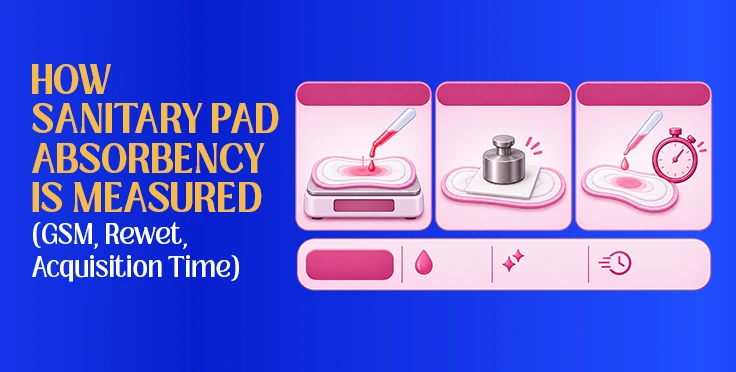
Absorbency performance
Fluid penetration or strike-through
Rewet and retention under pressure
Adhesive and wing attachment
Core integrity
Packaging and labelling accuracy
The applicable test methods and acceptance criteria should be agreed according to the product specification and relevant standards.
5. Traceability and Complaint Handling
Traceability helps a manufacturer identify which materials and production records relate to a particular finished batch. It also supports investigation if a buyer reports a product or packaging issue.
Ask whether the supplier maintains batch identification, production records, inspection records and a documented complaint-handling process.
For B2B buyers, this information is especially useful when managing repeat orders, private-label products and institutional supply.
Key Quality-Control Stages in Sanitary Pad Manufacturing
A buyer evaluating GMP sanitary pad manufacturing should understand the production stages and the checks associated with each one.
Manufacturing stage | What should be controlled | What B2B buyers can ask for |
Raw-material receipt | Material identity, condition and specification | Material specifications and incoming inspection records |
Material storage | Identification, handling and segregation | Storage and stock-control procedures |
Production preparation | Equipment condition and approved settings | Machine maintenance and setup procedures |
Pad assembly | Layer placement, dimensions and construction | In-process inspection details |
Performance testing | Absorbency, penetration, rewet and retention | Test methods and relevant test results |
Packaging | Pack count, sealing, labels and artwork | Packaging inspection checklist |
Finished-goods inspection | Product conformity and packing condition | Final inspection records |
Dispatch | Batch identification and order accuracy | Batch details and dispatch documentation |
The table is a buyer-assessment guide. The exact checks will depend on the product design, applicable standard and agreed purchase specification.
Important Quality Parameters for Sanitary Pads
A B2B buyer should understand the basic product parameters before approving a supplier. This makes it easier to compare samples and identify whether a manufacturer's process matches the commercial requirement.
Absorbency and Retention
Absorbency relates to the amount of fluid a pad can take in under a defined test method. Retention and rewet checks help assess how the absorbent structure behaves after fluid absorption and under pressure.
Ask the supplier to explain the test method, acceptance criteria and results for the product being quoted.
Topsheet and Surface Construction
The topsheet is the layer that comes into contact with the wearer. Its material, construction and bonding with the layers below it should be consistent with the approved sample.
Buyers should confirm whether the product uses a dry-net or cottony topsheet and whether the selected material is available for repeat production.
Absorbent Core Integrity
The absorbent core should remain properly positioned within the pad during use. Buyers can ask how the manufacturer checks for clumping, uneven distribution or construction defects.
Adhesive and Wing Performance
For products with wings, adhesive and wing construction should match the approved design. Buyers should check that the pad's positioning features and release paper are consistent with the product specification.
Packaging and Labelling
Packaging protects the product during storage and distribution and communicates essential product information. Buyers should confirm pack quantity, dimensions, artwork, batch details and any destination-market labelling requirements before production.
GMP Practices vs Product Certification: What Is the Difference?
One of the most important points for procurement teams is to distinguish manufacturing practices from product standards and formal certifications.
Term | What it generally refers to | What buyers should confirm |
GMP practices | Organised procedures and controls used during manufacturing | Which procedures are followed and what records are maintained |
Quality management system | A structured system for managing quality-related processes | Applicable certificate, scope, issuing body and validity |
Product standard | Technical requirements for a particular product category | Standard number, edition and product conformity evidence |
BIS/ISI certification | Indian conformity assessment and certification under applicable BIS requirements | Licence details, product scope and current validity |
Product test report | Results from specified tests on a product or sample | Test method, sample identity, date and issuing laboratory |
These terms are related, but they are not interchangeable. A manufacturer describing its processes as GMP-aligned does not, by that statement alone, establish that it holds a formal GMP certificate.
For sanitary napkins sold in India, buyers should also understand the applicable Indian product-standard and BIS requirements. SmilePad's sanitary-napkin information refers to IS 5405 and its product compliance approach. Buyers should request the relevant current documents and confirm their scope before relying on a compliance statement.
Understanding Feminine Hygiene Compliance for B2B Procurement
A sanitary pad manufacturer should be able to explain its quality procedures and provide relevant supporting documents. Buyers can explore SmilePad's certificates and quality credentials to understand the company's published certification and compliance information. Always review the certificate scope and validity before relying on any certification claim.
Before placing a bulk order, procurement teams should review the following areas.
Product and Standard Requirements
Confirm which product standard or technical specification applies. Ask the supplier to identify the standard followed and provide relevant conformity documents or test reports.
Certification Scope
A certificate should be reviewed carefully. Check:
The legal name of the certified organisation
The issuing certification body
The certificate number
The scope of certification
The relevant site or facility
The issue and expiry dates, where applicable
A certificate for one activity or site should not automatically be treated as proof that every product or manufacturing location is covered.
Market-Specific Requirements
For exports, the buyer and manufacturer should identify the applicable destination-market requirements before production and dispatch. This may include product registration, local labelling, importer documentation or other regulatory steps.
Documentation Availability
Ask the supplier what documents can be provided for the specific product and order. The buyer should maintain approved specifications, sample approvals, relevant test reports, purchase orders and shipment records.
B2B Quality Checklist: Questions to Ask a Sanitary Pad Manufacturer
Use this B2B quality checklist when comparing manufacturers or evaluating a new supplier.
No. | Buyer question | Why it matters |
1 | Can you share the product specification? | Confirms the agreed product design |
2 | How are raw materials inspected? | Helps assess material-control procedures |
3 | What in-process checks are performed? | Shows how production is monitored |
4 | Which performance tests are conducted? | Clarifies how product performance is evaluated |
5 | Can you share relevant test reports? | Provides supporting quality information |
6 | How are batches identified and recorded? | Supports traceability |
7 | How are non-conforming products handled? | Shows how production issues are managed |
8 | Can I approve a sample before bulk production? | Helps align expectations before an order |
9 | How are packaging and labels checked? | Reduces artwork and packing errors |
10 | Which certificates and licences apply to this product? | Helps assess compliance claims |
11 | Can you support private-label requirements? | Confirms branding and packaging capability |
12 | How are complaints and corrective actions managed? | Helps assess after-sales quality support |
Buyers should record each supplier's response and request supporting documents wherever relevant. A structured comparison is more useful than selecting a manufacturer based only on price.
How SmilePad Approaches Manufacturing and Quality Control
SmilePad is an India-based feminine-hygiene manufacturer offering B2B, OEM, private-label and bulk supply solutions. Its published manufacturing information describes a process that includes incoming material checks, in-process controls, final inspection and batch documentation.
For more information, review SmilePad's manufacturing, which describes its approach to production checks and quality management. Buyers can also learn about the sanitary pad sampling and testing process and explore its feminine hygiene manufacturing capabilities before discussing a bulk or private-label order.
This process is relevant to buyers who want to assess product specifications before committing to commercial production.
When discussing a new project with SmilePad, B2B buyers can clarify:
Product type, size and absorbency requirements
Topsheet and absorbent-core preferences
Packaging and private-label requirements
Sample development and approval
Relevant product standards and documentation
Bulk order and repeat-supply requirements
You can explore SmilePad's sanitary napkin manufacturing and product range and its manufacturing and quality-control process for further information.
Common Mistakes B2B Buyers Should Avoid
Even experienced procurement teams can overlook important details when selecting a sanitary-pad manufacturer. Avoid these common mistakes:
Choosing only by price: A lower quotation does not explain the material specification, testing process or documentation available.
Accepting broad quality claims: Ask for product-specific information instead of relying on general statements such as “premium quality”.
Confusing GMP practices with certification: Request the exact certificate and scope if a supplier claims formal certification.
Skipping sample approval: Approve the product and packaging before authorising bulk production.
Ignoring batch traceability: Understand how the manufacturer records production and identifies finished batches.
Not checking market requirements: Confirm applicable standards and destination-market rules before manufacturing or shipment.
Leaving specifications unclear: Record dimensions, materials, pack count, artwork and test expectations in the purchase documentation.
A clear specification and documented approval process can help prevent avoidable disagreements between the buyer and manufacturer.
Frequently Asked Questions
1. What is GMP in sanitary pad manufacturing?
GMP refers to Good Manufacturing Practices. In sanitary-pad manufacturing, buyers can use GMP-related principles to assess production controls, material handling, staff practices, inspections, documentation and traceability. The exact formal requirements depend on the applicable product category and jurisdiction.
2. Why is GMP important when choosing a sanitary pad manufacturer?
It gives buyers a framework for reviewing how a manufacturer controls production and maintains consistent product specifications. Buyers should assess actual procedures and supporting records rather than relying only on a general GMP claim.
3. Is GMP certification mandatory for all sanitary pad manufacturers?
GMP certification should not be assumed to be universally mandatory for every sanitary-pad manufacturer. Applicable product standards, licensing and certification requirements depend on the market and product category. Buyers should confirm the relevant requirements with the appropriate authority.
4. What quality tests should buyers ask for when sourcing sanitary pads?
Depending on the product specification, buyers may ask about absorbency, penetration speed, rewet, retention under pressure, dimensions, adhesive performance, core integrity and packaging checks. Ask for the relevant test methods and product-specific results.
5. What documents should a B2B buyer request from a sanitary pad manufacturer?
Commonly useful documents include product specifications, relevant test reports, sample approval records, applicable certificates or licences, batch information and packaging details. The exact documents depend on the product, buyer requirements and destination market.
6. How can buyers check whether a sanitary pad manufacturer follows good quality practices?
Ask for an explanation of raw-material inspection, in-process checks, final inspection, batch traceability, complaint handling and sample approval. Review available records and certificates within their stated scope before finalising the supplier.